
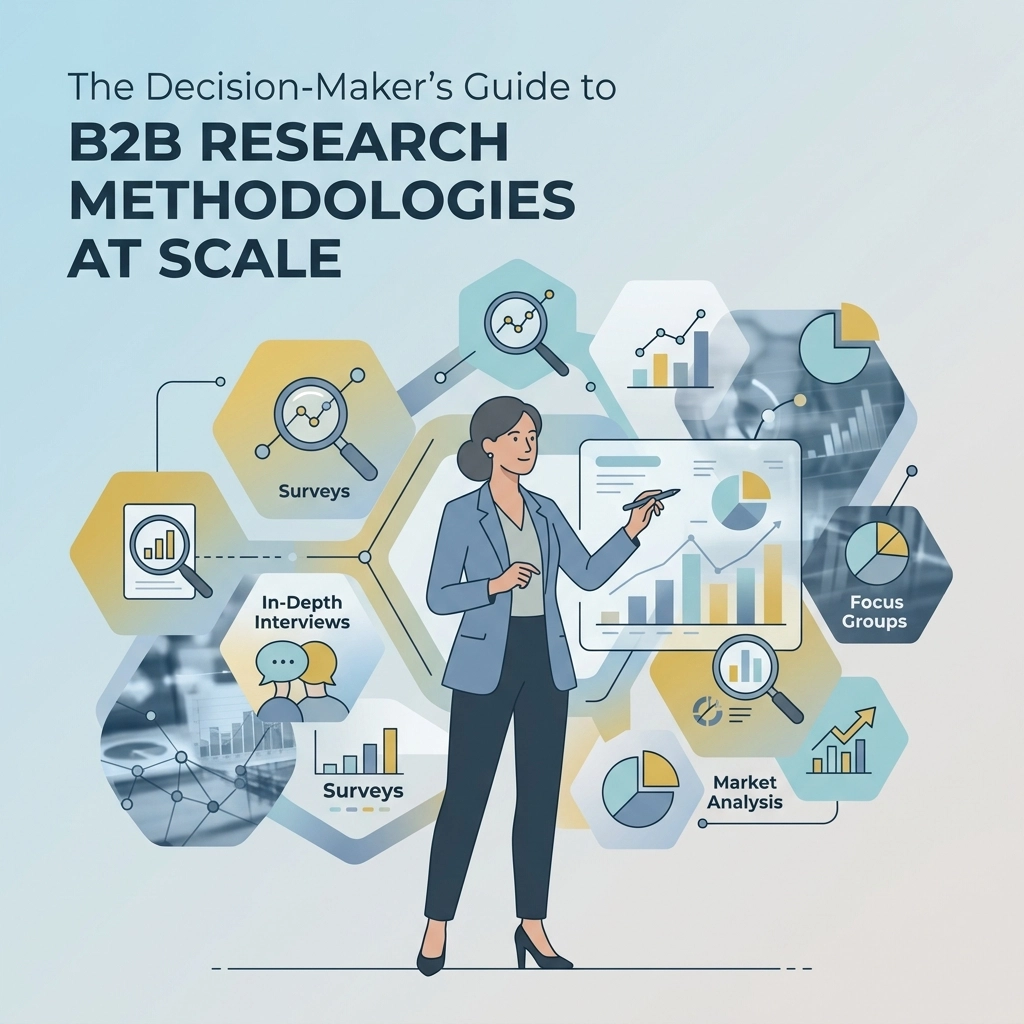
In the high-stakes arena of B2B enterprise, "gut feeling" is a liability. As a decision-maker, your ability to drive sustainable growth depends on the precision of your data. But how do you move beyond surface-level metrics to achieve deep, actionable insights across thousands of potential accounts?
The challenge isn't just gathering data; it’s scaling the B2B research methodologies that actually move the needle. Whether you are navigating the labyrinthine halls of healthcare market research or trying to sharpen your demand generation through intent data, scaling your insights is the only way to secure a competitive edge in 2026.
At AptZion, we don’t just provide data; we provide clarity. This guide breaks down the framework for executing market research at scale to ensure your next strategic move is backed by world-class intelligence.
WHY SCALE MATTERS IN B2B MARKET RESEARCH
Why should you care about scaling your research? Because in a globalized market, niche insights that don't scale are just anecdotes. To achieve true growth, you need a methodology that identifies patterns across entire industries while maintaining the "inch-perfect" accuracy of a one-on-one interview.
Scaling your research allows you to:
- De-risk high-value investments: Validate your GTM strategy before committing millions.
- Identify MQLs and SQLs with higher velocity: Stop chasing "ghost signals" and focus on buyers with actual intent.
- Understand the Buying Committee: Map the 6–10 stakeholders typically involved in a B2B purchase.
To understand why deep insights are the foundation of precision, explore how market research drives precision lead generation.
THE CORE B2B RESEARCH METHODOLOGIES
Executing research at scale requires a hybrid approach. You cannot rely solely on qualitative depth or quantitative breadth. You need both.
1. QUANTITATIVE RESEARCH (THE BREADTH)
Quantitative methods allow you to capture the "what" across a massive sample size.
- CAWI (Computer-Assisted Web Interviewing): High-speed, high-volume surveys.
- CATI (Computer-Assisted Telephone Interviewing): Essential for reaching high-level executives who don't answer emails.
- Market Segmentation: Utilizing firmographics and technographics to categorize your Total Addressable Market (TAM).
2. QUALITATIVE RESEARCH (THE DEPTH)
Qualitative methods reveal the "why." At scale, this is often the most difficult to achieve.
- In-Depth Interviews (IDIs): One-on-one sessions that uncover pain points and hidden motivations.
- Focus Groups: Facilitated discussions that highlight collective industry sentiment.
- Jobs-To-Be-Done (JTBD) Framework: Identifying exactly what "job" a customer is hiring your product to do.

THE "SANDWICH METHOD": A FRAMEWORK FOR SCALING INSIGHTS
How do you combine these without blowing your budget? We recommend the "Sandwich Method." This involves a three-phase approach that ensures your market research is both broad and deep.
- Phase 1: Exploratory Qualitative. Start with 10–15 IDIs to identify the core challenges and jargon used by your target audience.
- Phase 2: Quantitative Validation. Take the hypotheses from Phase 1 and test them against a sample of 500+ decision-makers using CAWI.
- Phase 3: Targeted Qualitative. Circle back to a handful of respondents to dig deeper into the "anomalies" or specific trends identified in Phase 2.
This framework is the gold standard for high-stakes markets. Learn more about the proven B2B research framework we use at AptZion.
HEALTHCARE MARKET RESEARCH: NAVIGATING THE GATEKEEPERS
In the healthcare sector, standard B2B tactics often fail. You aren't just dealing with "buyers"; you are dealing with Clinical Review Boards, Procurement Officers, and Chief Medical Officers. Healthcare market research requires a specialized lens of compliance and precision.
Precision in healthcare means understanding the clinical workflow and the regulatory hurdles that prevent a "yes." To scale here, you must utilize intent data to identify when a healthcare system is actively looking for a solution, allowing you to bypass traditional gatekeepers.
Failure to adapt leads to wasted outreach. Review our insights on fixing healthcare outreach mistakes to ensure your team isn't spinning its wheels.

INTENT DATA: THE GROWTH ACCELERANT
If research is the map, intent data is the GPS. Intent data tracks the digital breadcrumbs left by prospects: searches, whitepaper downloads, and webinar attendance: that signal a readiness to buy.
When you integrate intent data with your B2B research methodologies, you stop guessing who might be interested and start knowing who is currently in-market. This synergy is what separates robust growth from stagnation.
By layering social intent and search intent over your research findings, you can:
- Prioritize Accounts: Focus sales energy on the top 10% of accounts showing high-intent signals.
- Personalize Messaging: Tailor your content to the specific stage of the buyer’s journey.
- Shorten Sales Cycles: Engage prospects exactly when the "window of opportunity" is open.
Stop chasing ghosts. Read our guide on how to stop chasing ghost signals and start closing deals today.
LEVERAGING AI TO SCALE WITHOUT COMPROMISE
In 2026, scale is achieved through automation and AI. We are no longer limited by how many researchers we can hire. AI-powered market research allows for:
- Automated Triangulation: Cross-referencing survey data with CRM records and third-party intent signals in real-time.
- Sentiment Analysis at Scale: Analyzing thousands of open-ended survey responses in seconds.
- Predictive Modeling: Forecasting market shifts before they happen.
Using AI doesn't mean removing the human element; it means augmenting it. It allows your strategic team to focus on interpreting data rather than cleaning it.
Discover how AI is revolutionizing the future of insight for modern enterprises.

COMMON PITFALLS: WHAT TO AVOID
Even the best-funded research initiatives can fail if they fall into these common traps:
- Ignoring the Buying Committee: Focusing only on the C-suite while ignoring the "influencers" and "users" who can veto a deal.
- Data Silos: Keeping market research separate from your sales and marketing teams.
- Static Research: Treating research as a one-off project rather than a continuous loop of intelligence.
- Lack of Compliance: Especially critical in healthcare: failing to adhere to GDPR or HIPAA can end a project before it starts.
Avoid these expensive errors by checking out our list of 7 mistakes you’re making with B2B market research.
THE APTZION ADVANTAGE: WE GENERATE LEADS, YOU GENERATE PROFIT
At AptZion, we believe that research should be a revenue-generating activity, not a cost center. By combining high-level B2B research methodologies with real-time intent data, we provide the world-class insights you need to dominate your sector.
Are you ready to stop guessing and start growing? Our comprehensive approach to healthcare market research and B2B insights ensures that your GTM strategy is "inch-perfect."

TAKE THE NEXT STEP TOWARD PRECISION GROWTH
Scaling your research doesn't have to be an insurmountable challenge. It requires the right partner, the right technology, and a commitment to data-driven decision-making.
Whether you are looking to refine your healthcare market research or integrate intent data into your existing workflows, AptZion is here to deliver robust, ROI-driven solutions.
Ready to accelerate your growth?
Get in touch with our expert team today and let’s build your data-driven future together. For immediate inquiries, contact us at +44 204 513 3886.