
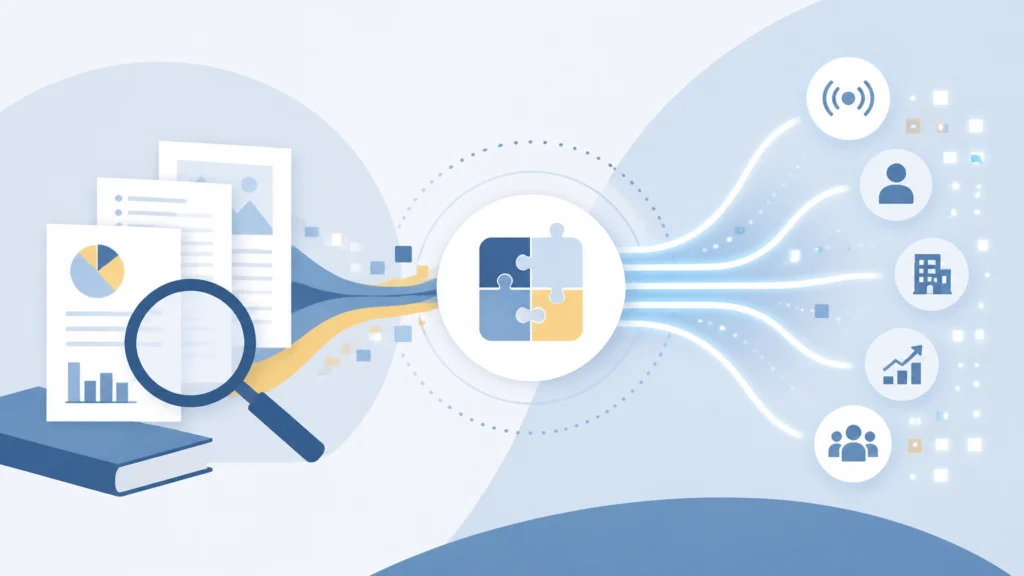
Is your growth strategy operating on yesterday’s news? In the high-stakes world of enterprise sales and healthcare solutions, relying on static lead lists is a recipe for stagnation. To achieve true hyper-growth, you must move beyond passive data collection. You need a dynamic engine that combines the depth of B2B research methodologies with the real-time precision of intent data.
At AptZion, we don’t just "find leads"; we architect growth systems. By integrating deep-dive primary research with behavioral signals, we empower you to identify exactly who is in-market, what they are looking for, and when they are ready to sign. This is the blueprint for inch-perfect market penetration.
DEFINING THE ARCHITECTURE OF HYPER-GROWTH: WHY INTEGRATION IS MANDATORY
The modern B2B buyer’s journey is complex, non-linear, and increasingly anonymous. If you wait for a prospect to fill out a form, you’ve already missed 70% of their decision-making process. Hyper-growth requires you to be proactive, not reactive.
Integration is the bridge between the "Who" and the "When."
- B2B Research Methodologies provide the "Why" and the "How." They define your Ideal Customer Profile (ICP), map the decision-making unit (DMU), and uncover the deep-seated pain points that drive a purchase.
- Intent Data provides the "Now." It tracks digital footprints: surges in content consumption, specific keyword searches, and white paper downloads: to tell you which accounts are currently in an active buying cycle.
When you fuse these two disciplines, you eliminate the guesswork. You stop shouting into the void and start engaging in high-value conversations with accounts that are statistically more likely to convert. This isn't just marketing; it's a strategic revenue operation.
ROBUST B2B RESEARCH METHODOLOGIES: THE FOUNDATION OF STRATEGY

You cannot scale what you do not understand. High-growth organizations utilize comprehensive B2B research methodologies to build a world-class foundation. This involves a rigorous blend of primary and secondary research designed to uncover market gaps and competitive vulnerabilities.
PRIMARY RESEARCH: THE VOICE OF THE DECISION-MAKER
To win, you must understand the psychology of your buyer. Our primary research goes straight to the source:
- In-Depth Interviews (IDIs): One-on-one sessions with key stakeholders (CXOs, VPs of Procurement) to understand their strategic priorities and barriers to entry.
- Quantitative Surveys: Robust data collection across a statistically significant sample to validate market trends and price sensitivity.
- Usage & Attitude (U&A) Studies: Precise mapping of how current solutions are used and where they fall short of expectations.
SECONDARY RESEARCH: THE DATA-DRIVEN BACKBONE
We complement primary insights with exhaustive secondary analysis, including:
- Competitive Intelligence: Analyzing competitor filings, product roadmaps, and market positioning.
- Market Sizing & Segmentation: Breaking down the Total Addressable Market (TAM) into Serviceable Obtainable Markets (SOM) with mathematical precision.
- Trend Analysis: Monitoring regulatory changes and technological shifts that create new windows of opportunity.
By leveraging these methodologies, you ensure your lead generation efforts are directed at the most fertile ground.
UNLOCKING PRECISION WITH INTENT DATA: THE GROWTH ACCELERATOR

Traditional research tells you who could buy. Intent data tells you who is buying. This is the difference between a broad-net approach and a sniper-focused strike.
Intent data monitors the "digital signals" that precede a purchase. When a multi-billion dollar Integrated Delivery Network (IDN) starts searching for "interoperability protocols" or "AI-driven diagnostics" multiple times across different IP addresses in their domain, that is a Surge.
THE THREE TIERS OF INTENT
- First-Party Intent: Data from your own assets: who is visiting your pricing page, downloading your case studies, or engaging with your email marketing campaigns?
- Third-Party Intent: Behavioral signals from across the web. What are they searching for on industry portals, third-party blogs, and competitor sites?
- Account-Based Intent: Aggregating these signals at the organization level to identify "Buying Committees" rather than just single leads.
By integrating intent signals into your CRM, your sales team can prioritize "hot" accounts, ensuring that their outreach is timely, relevant, and impossible to ignore.
HEALTHCARE MARKET RESEARCH: NAVIGATING COMPLEX DECISION MATRICES

For companies in the medtech, SaaS, or diagnostic sectors, the stakes are even higher. Healthcare market research is not a standard B2B play; it is a specialized discipline requiring an understanding of clinical workflows, payer reimbursement models, and stringent regulatory environments like HIPAA and GDPR.
In healthcare, the buyer is rarely a single person. You are selling to a "Buying Group" that includes:
- Clinical Leaders (CMIOs, Chief of Surgery): Focused on patient outcomes and ease of use.
- Financial Officers (CFOs): Focused on ROI, CAPEX vs. OPEX, and cost-containment.
- IT/Security Directors: Focused on data integrity, cloud security, and system integration.
Our specialized research methodologies allow you to map these complex relationships. When you layer intent data on top, you can see which specific hospital systems are currently researching new oncology platforms or telehealth solutions. This allows you to deploy content syndication strategies that speak directly to the concerns of each stakeholder in that specific IDN.
THE STEP-BY-STEP INTEGRATION PLAYBOOK

Ready to transform your growth engine? Follow this 4-step framework to integrate research and intent for maximum ROI.
STEP 1: VALIDATE YOUR ICP WITH BIG DATA
Use secondary research to identify the sectors with the highest growth potential (e.g., regional healthcare providers with over 500 beds). Cross-reference this with your historical sales data to create a "Gold Standard" ICP.
STEP 2: ACTIVATE REAL-TIME INTENT MONITORING
Deploy intent tracking for your top-tier accounts. Monitor for surges in keywords related to your core solution and your competitors. Set "Trigger Events": if an account surges for three consecutive weeks, they move to the top of the priority list.
STEP 3: CONDUCT TARGETED QUALITATIVE RESEARCH
Don’t just call the surging accounts. Use qualitative B2B research methodologies to understand the sentiment behind the surge. Conduct short, agile interview sprints with professionals in those surging segments to refine your messaging. Are they looking for "cost reduction" or "technological innovation"?
STEP 4: DEPLOY PRECISION DEMAND GENERATION
Once you have the "Who," the "When," and the "Why," execute your demand generation campaign. Use the insights from your research to create high-impact, stage-specific content that addresses the exact pain points identified.
THE APTZION GUARANTEE: WE GENERATE LEADS, YOU GENERATE PROFIT
Hyper-growth is not an accident; it is the result of a scientific approach to market intelligence. By combining the rigorous depth of specialized healthcare market research with the brisk, actionable signals of intent data, we provide a comprehensive, end-to-end solution that traditional vendors simply cannot match.
Are you ready to stop guessing and start growing? At AptZion, we specialize in building these high-performance engines for businesses that demand nothing less than world-class results.
Get in touch with our experts today to see how we can align our research methodologies with your growth goals. Let’s turn your data into revenue.