
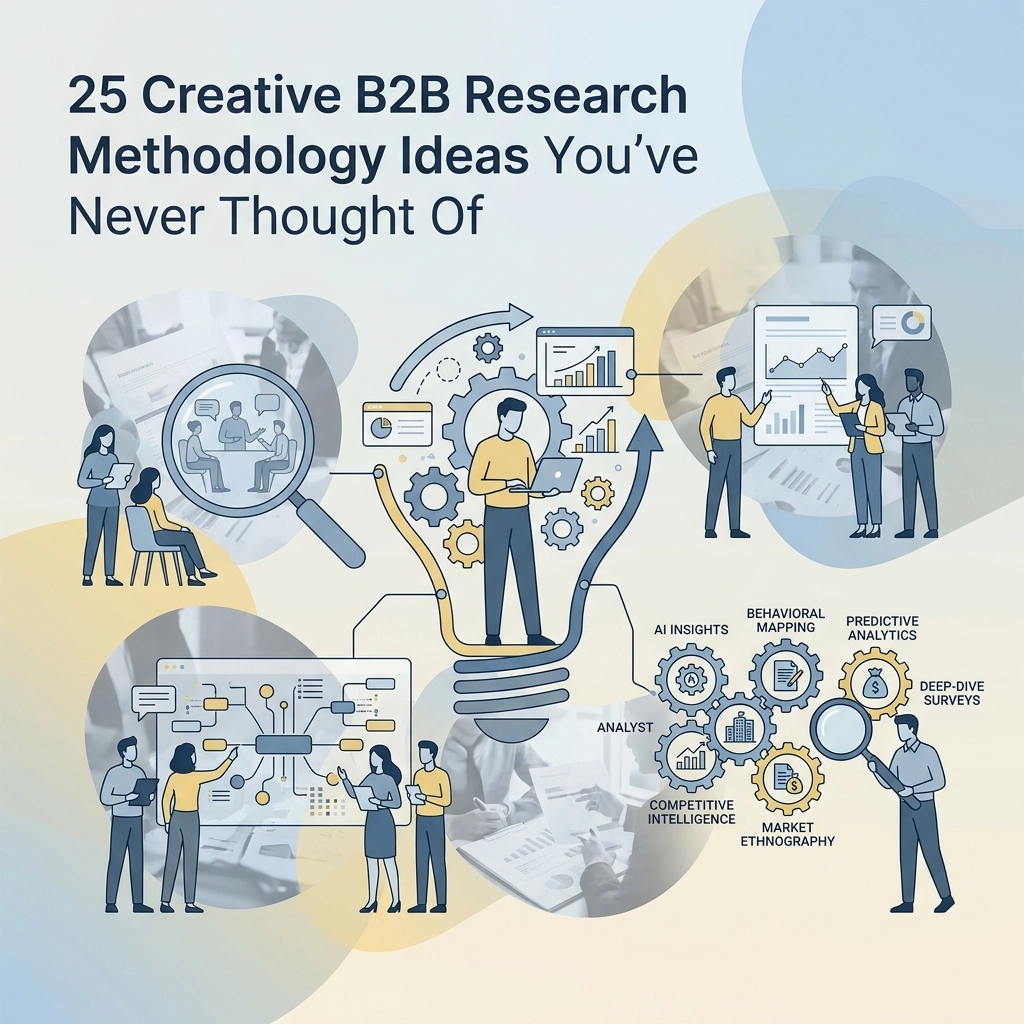
In the hyper-competitive landscape of 2026, surface-level surveys and generic feedback loops are no longer enough to drive sustainable growth. If you are relying on the same outdated tactics, you aren't just falling behind: you are actively losing market share to competitors who leverage deep, human-validated insights.
Traditional B2B research methodologies often fail because they treat buyers as data points rather than complex human systems. To scale your revenue and master your vertical, you need a radical shift in how you gather intelligence. Whether you are navigating the complexities of healthcare market research or looking to sharpen your use of intent data, these 25 creative methodologies will provide the robust, actionable data you need to dominate your sector.
1. Buying-Committee Reenactment Workshops
Recruit a recent customer account and have them reenact their last major purchase decision. By observing the internal politics, veto points, and decision criteria in a facilitated environment, you uncover the "unspoken" hurdles that stall your deals.
2. “Shadow the Champion” Longitudinal Diary Study
Identify your internal advocate and have them log every interaction: emails, meetings, and objections: related to your solution over a six-week period. This reveals the friction points your sales team never sees.
3. Deal-Room Ethnography
With permission, observe a complex opportunity from discovery to close. Sit in on internal deal reviews and Slack channels to learn how your team interprets buyer signals. Are you missing critical red flags? This methodology will tell you.
4. “Abandoned Proposal” Autopsies
Don't just focus on wins and losses. Analyze the "zombie" deals: the ones that went dark. Interviewing the prospect about shifting priorities or internal blockers reveals why your urgency isn't sticking. Avoid these 7 mistakes you’re making with B2B research methodologies and how to fix them (click to read) to ensure your autopsies yield real results.
5. Procurement Simulation Labs
Create a mock procurement game where participants manage a fixed budget and multiple vendor options. Observing how stakeholders overrule technical experts clarifies how to design your pricing and legal terms for a smoother close.

6. Calendar & Inbox Ethnography
Analyze anonymized metadata from key personas like CIOs or RevOps leaders. Understanding their meeting types and response times provides concrete constraints on their attention, allowing you to tailor your outreach to their reality.
7. Embedded Slack/Teams Researcher
Embed a research account within a customer’s internal channel dedicated to your product. Observing real-time workarounds and complaints provides a level of honesty that no scheduled interview can match.
8. Reverse Demos (Customer-As-Presenter)
Have your customers "demo" how they actually use your product: or a competitor’s. This surfaces critical UX issues and hidden use cases that scripted demos will never reveal.
9. “Future Press Release” Co-Creation Labs
Invite customers to write a hypothetical press release about their company two years after adopting your solution. Their chosen headlines and metrics will dictate your future value propositions and ROI models.
10. Adjacent-Role Stakeholder Triads
Bring together a buyer, an end-user, and a blocker (like IT security). Run group sessions to see live trade-offs between usability, risk, and cost. This is essential for navigating the high-stakes world of healthcare market research.
11. “No-Product” Problem Councils
Form councils where your brand is off-limits. Focus entirely on industry shifts, such as new regulations or technical hurdles. This uncovers latent needs uncolored by your current solution.
12. Pricing & Packaging Theater
Stage mock negotiations with your sales and finance teams. Role-play new pricing models to observe emotional reactions and non-starter clauses before you roll them out to the market.
13. Renewal & Churn Parallel Panels
Run two longitudinal panels: one for those who renewed and one for those who churned. Asking both the same questions over three months reveals the early warning signals of a failing account.
14. RFP Co-Authoring Sessions
Work with procurement leaders as they draft real RFPs. Understanding the "must-have" vs. "nice-to-have" criteria helps you align your collateral with the reality of the procurement process.
15. Conference Pathway Tracking
At industry events, track attendee movement across booths and lounges. Intercept those who followed specific paths (e.g., visited three AI vendors) for micro-interviews that link behavior with real-time intent data.

16. Content Path-Back Interviews
Reconstruct the last 90 days of a prospect's journey. Which blogs, webinars, and niche communities did they actually visit? Combine this with your analytics for a true map of the B2B content journey.
17. Job-Switch Journey Research
Interview decision-makers who recently changed companies. Which tools did they advocate to bring with them? This identifies which products are truly "beloved" and how to design portability plays.
18. Vendor-Stack Time-Lapse Mapping
Ask customers to map their tool stack over the last five years. Visualizing this evolution reveals category convergence and the triggers that lead to vendor consolidation.
19. Dark-Social Listening Panels
Recruit participants from private Slack groups and niche communities. Run confidential sessions about what is really said about your brand behind closed doors. This is where your reputation is truly built.
20. “What If We Disappeared?” Contingency Mapping
Ask customers to design a plan for if your product vanished tomorrow. Quantifying which workflows break helps you measure your true differentiation and replacement risk.
21. Multi-Org Decision-Journey Benchmarking
Map the end-to-end decision journey across several companies in the same segment. Normalizing these touchpoints allows you to benchmark durations and friction points, giving you a "standard" journey map to stress-test your funnel.
22. API Telemetry Labs
Instrument opt-in telemetry on how different segments integrate your services. Usage patterns combined with follow-up interviews surface hidden power users and new product opportunities.
23. Live Build-Along Research Sprints
Watch customers build a workflow or dashboard live. Observing where they hesitate or improvise is significantly richer than standard usability testing because it solves a real business problem in real-time.
24. AI-Assisted Open-Text Experiments
Use AI to cluster narratives from large-scale open-text survey questions. Follow up with specific clusters for deep-dive interviews. This is how you combine quantitative scale with the truth about human-validated insights (read more).
25. Continuous “Rolling Deals” Research Program
Set up an always-on pipeline where a subset of live deals is tagged for research. Pre-call surveys and post-decision debriefs build a live, evolving dataset of how deals are won and lost in 2026.

Scaling Your Methodology for 2026
The era of "set it and forget it" research is over. Whether you are refining your B2B research methodologies to capture more high-value accounts or looking for the ultimate guide to intent data (view guide), precision is your only path to ROI.
Specialized sectors, particularly in healthcare market research, require an even higher level of compliance and professional oversight. You cannot afford to rely on surface-level data when making million-dollar decisions. By integrating these creative methodologies, you move beyond "guessing" what your market wants and start "knowing" how to lead it.

At AptZion, we specialize in providing the strategic consultancy and research depth required to scale growth briskly. Don't settle for lead lists when you can have a comprehensive insights engine.
For more on how to implement these strategies at scale, explore the ultimate guide to B2B research methodologies (click here).
Ready to transform your market intelligence into revenue? Get in touch with AptZion today.