
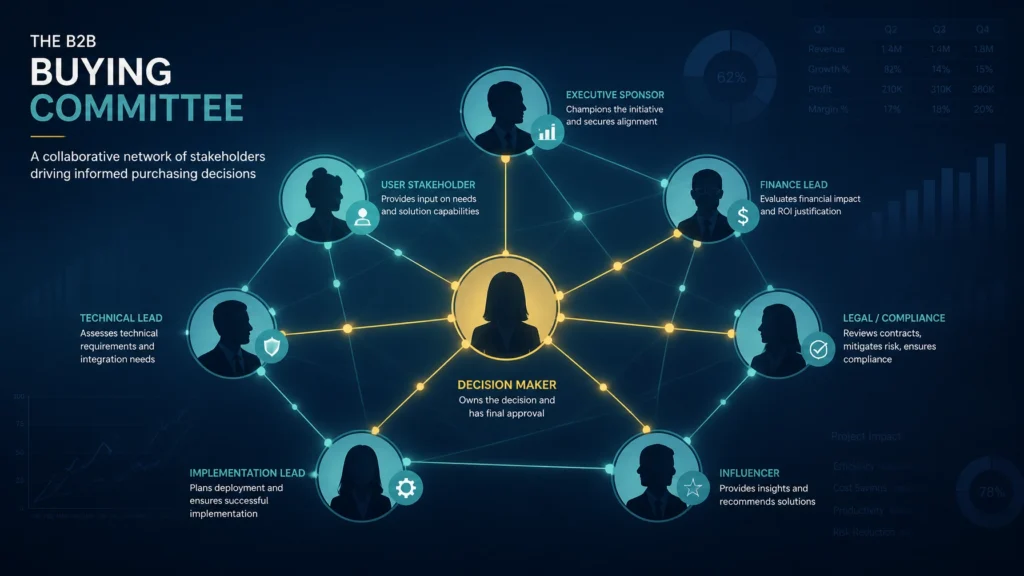
Is your sales team spinning their wheels on high-volume leads that never convert? In the world of enterprise sales, chasing a single lead is a recipe for a "closed-lost" status. Today’s B2B buying landscape has shifted dramatically; you aren't just selling to one person, you are selling to a complex, multi-layered buying committee. According to recent industry data, the average enterprise deal now involves anywhere from 6 to 10 stakeholders, each with their own agendas, biases, and veto power.
If you want to secure world-class revenue growth, you must move beyond the "one-lead" mindset. You need a robust strategy to identify, map, and influence the entire decision-making unit. At AptZion, we specialize in the precision targeting and modern B2B research methodologies required to navigate these intricate corporate structures.
Here is your 5-step playbook to mapping buying committees and closing enterprise deals with inch-perfect precision.
STEP 1: DEFINE THE BUYING SCENARIO AND TARGET ACCOUNTS
Before you send a single email, you must understand the "why" and "how" of your target accounts. Not all enterprise deals are created equal. Are you providing a new initiative, a replacement for a legacy system, or an expansion of existing services? Each scenario carries a different level of risk and a different committee structure.

You must analyze your historical "closed-won" data to build a deal blueprint. Identify which departments typically get involved, is it IT, Finance, Operations, or Legal? By blueprinting these scenarios, you transition from reactive selling to proactive account orchestration. Stop relying on static lead lists and start focusing on high-intent accounts that fit your Ideal Customer Profile (ICP). This foundational step ensures your resources are allocated to accounts where the ROI is guaranteed to be highest.
STEP 2: IDENTIFY AND TAG THE CORE BUYING ROLES
Once you have your target accounts, it’s time to unmask the players. In an enterprise environment, job titles can be deceptive. You need to map roles based on their actual influence within the deal. Every committee has:
- The Economic Buyer: The P&L owner (CFO or VP) who cares about the bottom line, ROI, and total cost of ownership.
- The Champion: Your internal advocate who will drive the project when you aren't in the room.
- The Technical Buyer: The IT or Security expert who evaluates feasibility and integration. They are often your biggest potential blockers.
- The Influencers: Subject matter experts whose opinions carry weight with the decision-makers.
- The Gatekeepers: Procurement and Legal teams who focus on risk and contract compliance.
By utilizing Dark Intent Signals, you can identify which of these stakeholders are already researching solutions in your space. This data-driven approach allows you to tag these roles in your CRM and build a visual map of reporting lines and trust networks.
STEP 3: EXECUTE MULTI-THREADED CONTENT SYNDICATION
Sending the same generic PDF to a CFO and a Lead Developer is a rookie mistake. To close enterprise deals, your messaging must be multi-threaded and role-specific. You need to provide a coherent story that speaks to each stakeholder’s unique reality.

- For the CFO: Deliver whitepapers focused on financial impact, risk mitigation, and briskly paced ROI.
- For the Technical Buyer: Provide detailed API documentation, security certifications, and scalability benchmarks.
- For the End-User: Focus on usability, workflow efficiency, and how your solution solves their daily pain points.
AptZion’s content syndication services ensure that your high-value assets reach the right eyes at the right time. By saturating the committee with relevant value, you establish professional credibility across the entire organization simultaneously.
STEP 4: ENGINEER CONSENSUS WITH A MUTUAL ACTION PLAN (MAP)
The biggest deal-killer in enterprise sales isn't a "no": it’s "no decision." This happens when the buying committee cannot reach a consensus. To prevent this, you must step into the role of a strategic consultant.
Identify your Champion and equip them with an internal "Battlecard." This should include pitch decks and business cases they can use to defend your solution during internal meetings. Furthermore, introduce a Mutual Action Plan (MAP). This is a shared document that outlines the timeline, decision milestones, and responsibilities for both parties. A MAP transforms a vague sales cycle into a disciplined project with a clear path to go-live. It keeps the committee aligned and ensures that no one is surprised by upcoming requirements like security audits or legal reviews.
STEP 5: DE-RISK, NEGOTIATE, AND CLOSE
As you approach the finish line, the focus shifts from "Value" to "Risk." Every member of the committee is looking for reasons why this might fail. Your job is to systematically dismantle these objections.

Provide world-class proof points: case studies with quantifiable outcomes, third-party audits, and industry-specific benchmarks. If the perceived risk is high, consider offering a limited-scope pilot or a phased rollout to lower the barrier to entry. Bring in your own "Legal and Procurement" specialists early to align on contract terms and avoid last-minute redlines that could stall the deal.
When you track engagement at the account level rather than the lead level, you can see exactly who has gone dark and who is still leaning in. If the Economic Buyer hasn't opened your last three emails, it's time to trigger a new outreach angle or ask your Champion for a warm intro.
THE APTZION ADVANTAGE: WE GENERATE LEADS, YOU GENERATE PROFIT
Mapping a buying committee is a labor-intensive process that requires precision, data, and persistence. You don't have to do it alone. AptZion provides the end-to-end demand generation and market research infrastructure you need to scale your enterprise sales operations.
Whether you are in healthcare, recruitment, or finance, our precision targeting ensures that your sales team spends their time closing, not just prospecting. Are you ready to stop guessing and start growing?
Get started with AptZion today and transform your pipeline into a predictable revenue engine.