
Are you tired of seeing your healthcare MQLs (Marketing Qualified Leads) vanish into a black hole the moment they hit the "Request a Demo" stage? You aren't alone. Most healthcare technology and professional service providers are running an outdated playbook: targeting a single decision-maker when the modern B2B healthcare landscape has evolved into a fortress of bureaucracy.
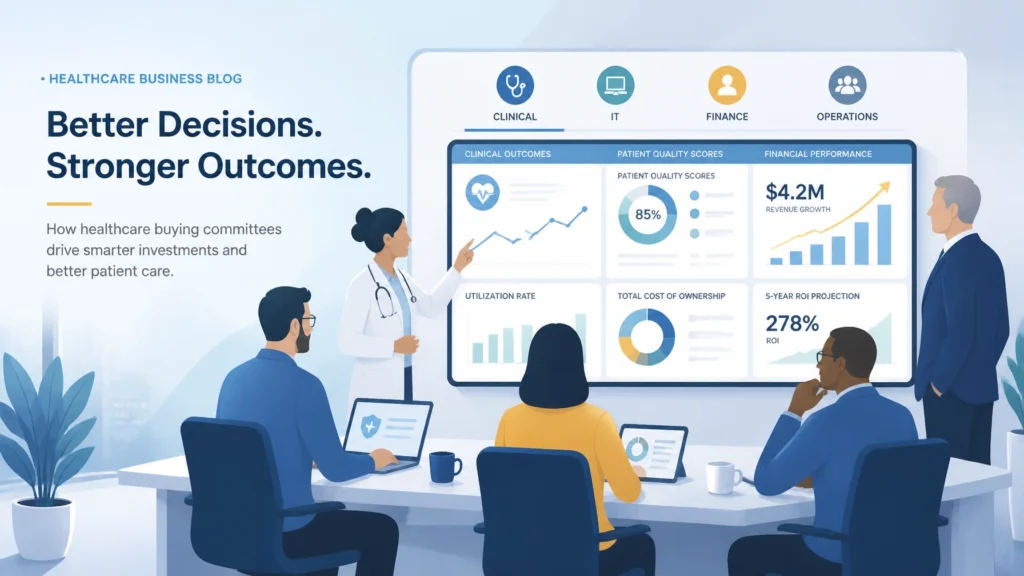
In healthcare, you aren't selling to a person; you are selling to a 22-stakeholder buying committee. This includes Chief Medical Officers (CMOs), IT Security Directors, Compliance Officers, CFOs, and Procurement Managers: each with the power to veto your deal. If your lead generation strategy isn't built for this complexity, your revenue will continue to stall.
At AptZion, we specialize in high-precision, data-driven strategies that penetrate these complex committees. Below are the seven fatal mistakes you are likely making and the world-class solutions to fix them.
MISTAKE 1: TREATING HEALTHCARE LIKE STANDARD B2B (THE SINGLE-BUYER MYTH)
Most marketers optimize their campaigns for a single champion: usually a clinician or a department head. While their interest is vital, they rarely have the final signature authority. In a 22-person committee, your champion is just one voice. If the IT Director or the Compliance Lead hasn't heard of you until the contract stage, they will view you as a risk, not a partner.
THE FIX: Adopt an Account-Based Marketing (ABM) framework. Instead of measuring success by individual leads, measure it by "Account Penetration." Your goal is to ensure that at least 5–7 key stakeholders within a target hospital or health system have engaged with your brand before a sales call even occurs. This builds the foundational trust necessary to survive the evaluation phase.

MISTAKE 2: POOR BUYING COMMITTEE MAPPING (THE INVISIBLE VETO-HOLDERS)
Do you know who actually signs the check? Often, the economic buyer (CFO) or the technical gatekeeper (CIO) is invisible during the early stages of the funnel. If you aren't actively mapping these roles, you are flying blind. Many deals fail not because the product is bad, but because a hidden stakeholder: like a legal counsel or a data privacy officer: raised a concern three months into the process.
THE FIX: Use B.A.N.T. (Budget, Authority, Need, Timeline) profiling at the account level. During discovery, ask explicitly: "Who owns IT integration and security?" and "Who is the economic buyer for this budget cycle?" Map these personas into your CRM and use content syndication to deliver specific whitepapers to these "invisible" stakeholders early in the cycle.
MISTAKE 3: GENERIC MESSAGING INSTEAD OF ROLE-BASED SEQUENCES
Sending the same "value proposition" email to a Doctor and a CFO is a recipe for high bounce rates and zero ROI. A clinician cares about patient outcomes and workflow efficiency. A CFO cares about TCO (Total Cost of Ownership) and ROI (Return on Investment). An IT Director cares about SOC 2 compliance and API integrations.
THE FIX: Develop role-based messaging tracks. Your demand generation campaigns should be segmented by persona.
- Clinical Track: Focus on evidence-based outcomes and clinical guidelines.
- Finance Track: Focus on budget impact and payback periods.
- Technical/Security Track: Focus on architecture, data encryption, and uptime guarantees.
MISTAKE 4: LEADING WITH FEATURES INSTEAD OF COMPLIANCE AND TRUST
In the healthcare sector, risk is the primary objection. If your marketing materials focus on "AI-driven insights" but bury your HIPAA compliance or SOC 2 certification in a footer, you are losing credibility. Healthcare buyers are risk-averse; they have been burned by poor integrations and security breaches before.
THE FIX: Lead with your "Trust Assets." Every landing page should prominently feature your certifications, data handling policies, and risk mitigation strategies. Present your service as a "robust" and "secure" solution first, and a feature-rich tool second. This positions you as a strategic partner who understands the high stakes of healthcare data.

MISTAKE 5: RUNNING SHORT-TERM CAMPAIGNS IN A 24-MONTH SALES CYCLE
Are you stopping your nurture sequences after 30 days? That is a mistake. The average healthcare technology purchase takes 12 to 24 months. If your lead generation strategy only focuses on "the now," you are missing out on the vast majority of the market that is currently in the "Education" phase rather than the "Buying" phase.
THE FIX: Design "Infinite Nurture" sequences. Your email marketing shouldn't just be about booking a demo; it should be about becoming an industry thought leader. Provide value through quarterly deep-dives into regulatory changes or market trends. Stay top-of-mind so that when the 18-month budget cycle finally opens, you are the only logical choice.

MISTAKE 6: OPTIMIZING FOR LEAD VOLUME INSTEAD OF ACCOUNT-LEVEL ROI
High MQL volume is a vanity metric if those leads never convert to SQLs (Sales Qualified Leads) or closed revenue. Chasing a low CPL (Cost Per Lead) often results in poor-quality, non-intent data that wastes your sales team's time. In healthcare, one high-quality SQL from a major health system is worth more than 500 random email signups.
THE FIX: Shift your KPIs to "Pipeline Value Created" and "Account Engagement Score." Use Intent Data to identify accounts that are actively searching for your solution. By focusing on quality over quantity, you ensure that your sales team is only speaking to high-intent decision-makers, briskly moving them toward a contract.

MISTAKE 7: SLOW FOLLOW-UP AND DISCONNECTED SALES-MARKETING ALIGNMENT
Speed-to-lead is critical. In a complex committee, the moment a stakeholder shows interest, you must strike. If your marketing team generates a lead and it sits in a CRM for three days before a sales rep reaches out, the momentum is lost. Furthermore, if Sales is using different messaging than Marketing, it creates a disjointed experience that erodes trust.
THE FIX: Implement a "Brisk Execution" protocol. Establish clear Service Level Agreements (SLAs) where every inbound healthcare lead is contacted within 60 minutes. Use a unified dashboard where both teams can see the stakeholder map and the engagement history of the entire account. Consistency across every touchpoint is the hallmark of a world-class organization.
WE GENERATE LEADS, YOU GENERATE PROFIT
Navigating the healthcare buying committee is a mathematical challenge that requires precision, data, and relentless consistency. You cannot afford to make these seven mistakes in a market where the competition is fierce and the stakeholders are numerous.
Are you ready to unlock growth through inch-perfect healthcare lead generation? AptZion’s comprehensive services are designed to help you dominate your market and scale your operations with confidence.
Don't leave your revenue to chance.
Get in touch with our experts today and let’s build a robust demand generation engine that delivers guaranteed results.