
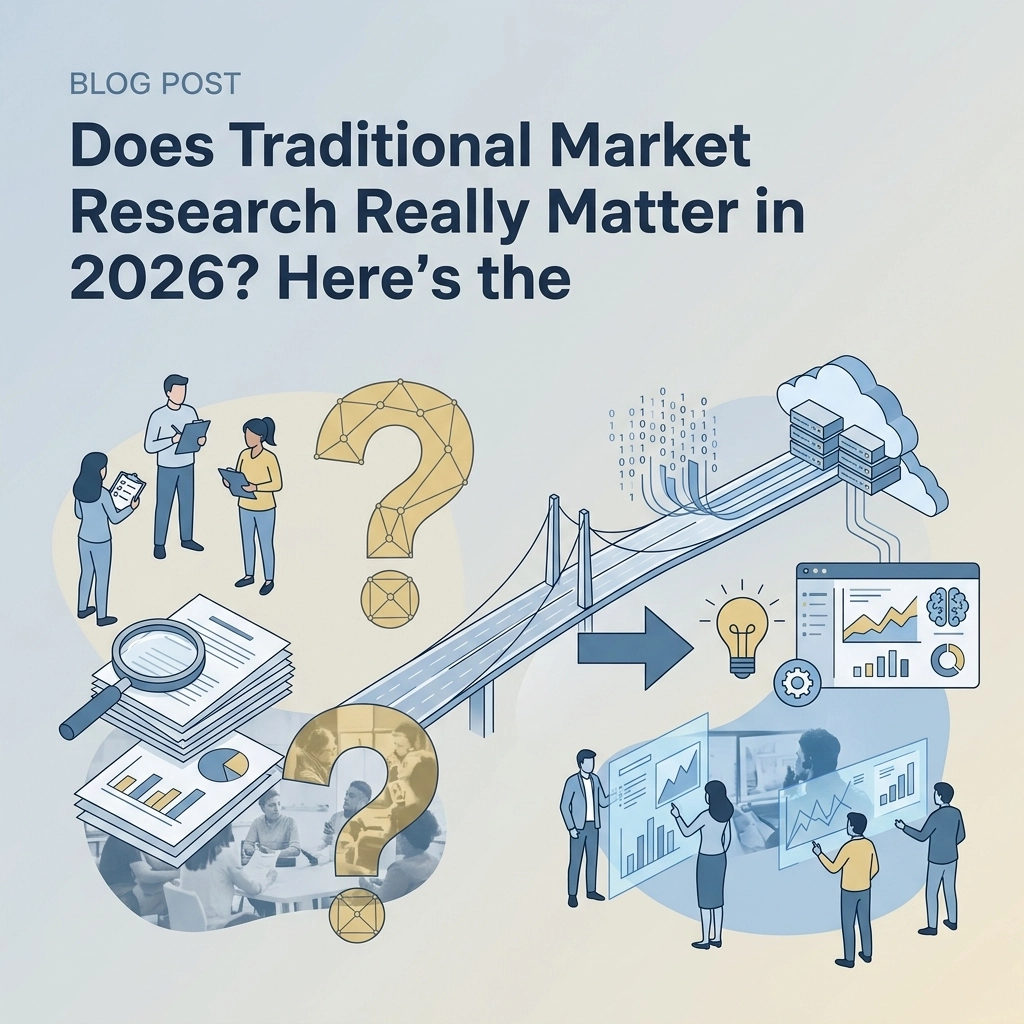
Is traditional market research dead? If you ask a CMO in 2026, you’ll likely get a complicated answer. For years, the industry relied on the "wait and see" model: long-form surveys, focus groups that took months to organize, and static reports that were often obsolete by the time they reached the boardroom.
But as we sit in the second quarter of 2026, the market landscape has shifted. We are no longer in the era of experimentation; we are in the era of integration. The truth is that traditional market research doesn't just matter: it has become a non-negotiable strategic capability for any business looking to achieve sustainable growth. However, the way we conduct that research has been fundamentally disrupted.
At AptZion, we’ve seen the shift firsthand. Purely traditional methods are failing because they cannot keep up with the briskly moving digital economy. To survive in 2026, your research must be high-velocity, AI-enhanced, and driven by multi-signal intent data.
The Death of the Glacial Research Cycle
In the past, a standard B2B market research project could take six to twelve weeks. In today's market, a six-week delay is an eternity. By the time you’ve analyzed your MQLs (Marketing Qualified Leads) and mapped out your competitors, the market has already pivoted.
Traditional research often suffers from "ghost signals": data points that look promising but lead to dead ends because they lack context or are outdated. This is why many organizations are moving toward intent data to stop chasing ghost signals.
The new standard is the 48-hour insight cycle. Decision-makers no longer want a 50-page PDF; they want a dynamic dashboard that reflects real-time audience sentiment and competitive shifts. If your research methodology isn't providing "always-on" measurement, you aren't just behind: you're invisible.

Why AI-Powered Research is the New Gold Standard
If 2025 was the year we played with AI, 2026 is the year we’ve integrated it into the very DNA of professional services. AI has moved beyond simple automation; it is now the primary engine for predictive analytics and deep audience segmentation.
Traditional research relied on human analysts to find patterns in spreadsheets. Today, AI-powered market research utilizes Natural Language Processing (NLP) to analyze thousands of social signals, search queries, and even internal CRM data simultaneously. This allows for:
- Predictive Lead Scoring: Identifying which prospects meet the B.A.N.T (Budget, Authority, Need, Timeline) criteria before they even fill out a form.
- Hyper-Personalization: Crafting messaging that resonates with specific buyer personas at a granular level.
- Sentiment Analysis at Scale: Understanding not just what your audience is saying, but the underlying emotional intent behind their queries.
Leveraging AI doesn't mean removing the human element. On the contrary, it frees up your strategic partners to focus on the why behind the data. This synergy is exactly how AI is revolutionizing market research in 2026.
Beyond the Survey: The Rise of Multi-Signal Intent Data
For decades, the survey was the king of research. But in 2026, stated intent (what people say they will do) is often vastly different from revealed intent (what people actually do).
This is where multi-signal research comes into play. By combining traditional survey data with search intent, social listening, and content syndication signals, you get a 360-degree view of your prospect.
Why does this matter? Because search intent alone is no longer enough. We have entered an era where social intent is the new gold mine. Professionals are making buying decisions based on peer recommendations, LinkedIn engagement, and specialized community discussions long before they ever hit a Google search bar. If your market research isn't capturing these "dark social" signals, your growth strategy is built on a hollow foundation.

The 7 Mistakes You’re Making with B2B Research
Even with the best tools, many companies fall into the same traps that lead to stalled ROI and wasted marketing spend. At AptZion, we focus on precision targeting to ensure our clients avoid these pitfalls.
Are you making these common errors?
- Relying on Single-Source Data: Only looking at SERPs or only looking at surveys.
- Ignoring the Post-Purchase Loop: Failing to research why customers stay or leave.
- Static Buyer Personas: Using personas created two years ago in a six-month-old market.
- Data Silos: Keeping market research separate from the sales and product teams.
- Focusing on Volume Over Quality: Chasing thousands of low-intent leads instead of high-value SQLs.
- Slow Speed to Insight: Taking weeks to act on a market shift.
- Neglecting Search Intent Integration: Failing to see how SEO and market research work together to drive organic growth.
For a deeper dive into these challenges, check out our guide on 7 mistakes you’re making with B2B market research.
A Framework for High-Stakes Markets
In professional services, the stakes are high. Whether you are in healthcare, finance, or enterprise SaaS, a single wrong move can cost millions in lost revenue. This is why we advocate for proven B2B research methodologies.
Our framework at AptZion focuses on three core pillars:
- Precision: Using deep insights to drive precision lead generation.
- Agility: Integrating real-time data feeds to adjust strategies on the fly.
- Compliance: Especially in sectors like healthcare, ensuring that content syndication and research follow strict regulatory guidelines.
By following a structured B2B research methodologies guide, you ensure that every dollar spent on research translates directly into business growth and increased market share.

Engagement Strategies for the 2026 Audience
The modern B2B buyer is overwhelmed with noise. Traditional outreach often feels like spam. To cut through the clutter, your market research must inform your engagement strategy.
It’s about moving from "interruption" to "integration." When you understand the specific pain points and search behaviors of your audience, you can provide value before you ever ask for a meeting. This is the difference between a cold call and a warm introduction facilitated by data.
If you are struggling with outreach, you might be falling victim to the 7 mistakes of precision targeting. The fix is simple: stop guessing and start leveraging deep B2B insights.

The Verdict: Transitioning to the New Reality
Does traditional market research really matter in 2026?
The answer is a resounding yes: but only if it is evolved.
The "Truth" is that the line between qualitative and quantitative research has blurred. The most successful firms are the ones that integrate intent data with B2B research methodologies to accelerate growth. They don't view research as a cost center; they view it as a profit engine.
We are no longer looking for "answers"; we are looking for "advantages." In a world where everyone has access to information, the advantage goes to those who can interpret that information faster and more accurately than the competition.
Market research in 2026 is about more than just understanding the market: it’s about defining it. Whether you are looking for the ultimate guide to 2026 trends or a partner to help you navigate these complexities, the path forward is clear.
At AptZion, we help you bridge the gap between data and deals. We don't just provide insights; we provide the roadmap to sustainable business growth. Because in 2026, market research matters more than ever.
Ready to transform your market research from a static report into a growth engine?
See our recent projects or explore our full range of services to see how we can help you scale with precision.