
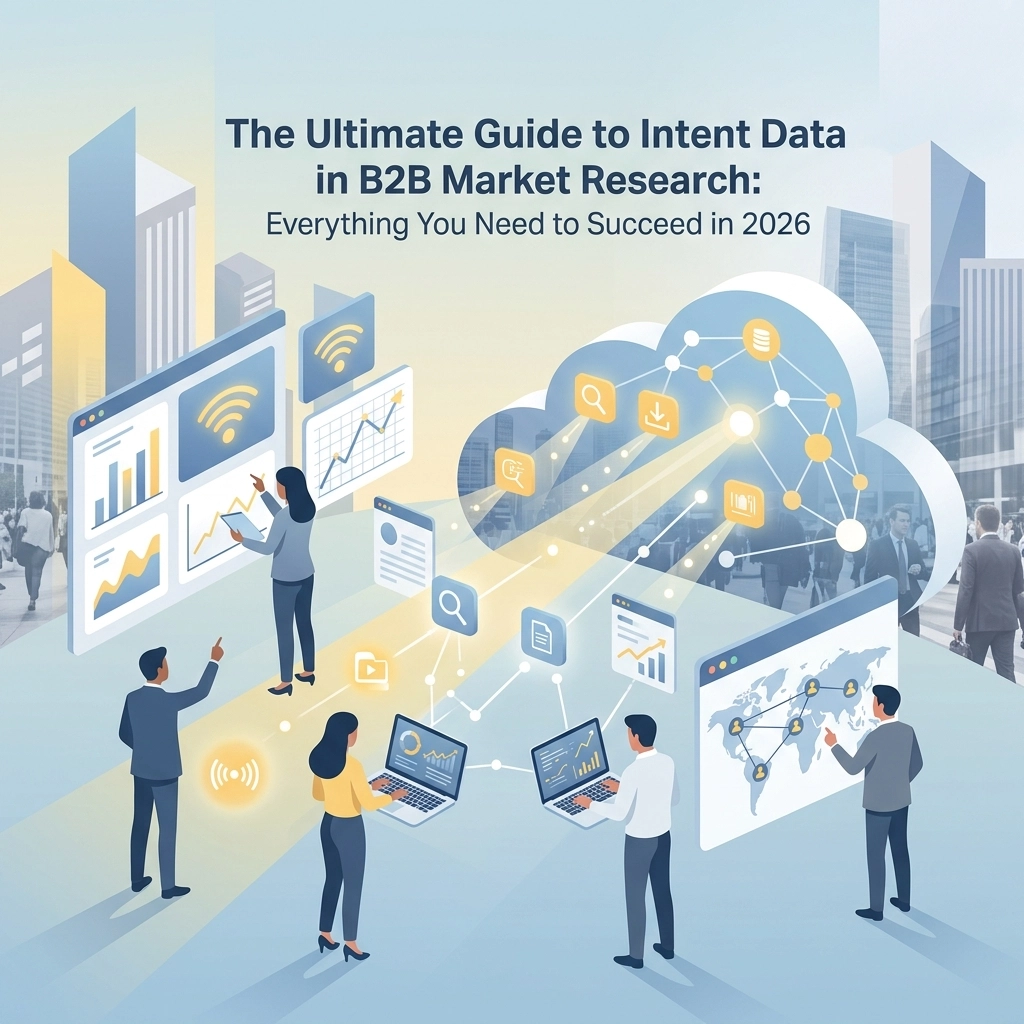
In the hyper-competitive landscape of 2026, traditional market research is no longer enough to sustain double-digit growth. If you are relying solely on historical data or static firmographics, you are effectively driving by looking through the rearview mirror. To win today, business executives must embrace intent data, the digital breadcrumbs that signal exactly when, where, and why a prospect is ready to buy.
At AptZion, we recognize that the fusion of high-level B2B research methodologies and real-time intent signals is the only way to achieve precision lead generation. This guide will walk you through the evolution of market research, specifically within high-stakes sectors like healthcare, and provide a robust framework for integrating intent into your growth strategy.
THE EVOLUTION OF MARKET RESEARCH: FROM STATIC TO SIGNAL-DRIVEN
Why does traditional research often fail to move the needle on immediate revenue? Because it focuses on the "Who" and the "What" while ignoring the "When." In 2026, the "When" is determined by intent.
Market research used to be a quarterly exercise. Today, it is a continuous stream of intelligence. By leveraging intent data, you can identify accounts that are actively surging on topics relevant to your solutions. This transitions your marketing from "interruptive" to "consultative." When you reach out to a prospect who has just spent three days researching B2B insights, your value proposition isn't noise, it’s the solution they’ve been looking for.
THE THREE TIERS OF INTENT DATA
- First-Party Intent: Data collected from your own properties, website visits, webinar sign-ups, and whitepaper downloads.
- Second-Party Intent: Data from review sites or partner networks (e.g., G2 or TrustRadius) showing who is comparing you to competitors.
- Third-Party Intent: The "Gold Mine." Broad-spectrum data from across the web that identifies which companies are researching your category before they ever land on your site.
HEALTHCARE MARKET RESEARCH: A CASE FOR PRECISION
Nowhere is the need for precision more acute than in healthcare market research. Dealing with hospital administrators, clinical directors, and Chief Medical Officers requires a level of nuance that generic B2B tactics cannot provide.
In the healthcare sector, intent signals are often buried in peer-reviewed journals, medical forums, and regulatory compliance searches. A "signal" might be a hospital system researching "interoperability standards" or "AI-driven diagnostic accuracy." If you are a medical device or SaaS provider, knowing these signals allows you to bypass the gatekeepers and speak directly to the pain points currently being discussed in boardrooms.
Using multi-signal research ensures you aren't just chasing "ghost signals" but are targeting decision-makers with a documented need for intervention.

ROBUST B2B RESEARCH METHODOLOGIES FOR 2026
To truly succeed, you must integrate intent data into a broader framework of B2B research methodologies. Intent tells you someone is looking; methodology tells you why they will choose you.
1. QUANTITATIVE SURGE ANALYSIS
By analyzing the volume of search queries and content consumption across specific clusters, we can identify "market surges." If a specific industry vertical, say, pharmaceutical manufacturing, shows a 400% increase in research for "supply chain transparency," that is a market opportunity that requires immediate attention.
2. QUALITATIVE DECISION-MAKER PROFILING
Once intent identifies the account, qualitative research defines the persona. What are the specific psychological triggers for a CFO in a mid-market manufacturing firm? We combine intent with proven frameworks to ensure your outreach hits the mark every time.
3. COMPETITIVE INTELLIGENCE & GAP ANALYSIS
Intent data allows you to see which prospects are researching your competitors. This is the ultimate defensive and offensive tool. By understanding the gaps in your competitor's offerings that prospects are actively searching for, you can position your product as the superior alternative briskly.

LEVERAGING INTENT FOR LEAD AND DEMAND GENERATION
The ultimate goal of any research initiative is growth. In 2026, the line between "Research" and "Sales Development" has blurred.
Demand Generation is no longer about filling a funnel with "maybe" leads. It is about harvesting the existing demand that intent data has identified. When you align your content syndication and SEO strategies with intent signals, you create a self-sustaining growth engine.
FROM MQL TO SQL: THE B.A.N.T. ACCELERATOR
Traditional B.A.N.T. (Budget, Authority, Need, Timeline) qualification is slow. Intent data accelerates this by pre-qualifying the "Need" and "Timeline." If an account is surging on high-intent keywords, their timeline is likely "Now." This allows your sales team to focus their energy on closing deals rather than qualifying cold leads.
Check out our guide on integrating intent with B2B methodologies to see how this works in practice.
COMMON PITFALLS: WHY MOST FIRMS FAIL AT INTENT
Despite the power of these tools, many organizations fail to see an ROI. The reasons are usually consistent:
- Data Silos: Marketing sees the intent, but Sales never gets the alert.
- Lack of Context: Chasing a single keyword search without understanding the broader market research context.
- Ignoring ICP Fit: Just because a company is researching your solution doesn't mean they are a good fit. Intent without an Ideal Customer Profile (ICP) is just noise.
To avoid these, you need a partner who understands the "inch-perfect" nature of high-stakes outreach. Whether it's fixing healthcare outreach mistakes or refining your general B2B strategy, precision is the only path to profit.

THE APTZION ADVANTAGE: WE GENERATE LEADS, YOU GENERATE PROFIT
At AptZion, we don't just provide data; we provide a world-class strategic partnership. Our approach to Professional Services is built on the foundation of transparency and innovative solutions. We understand that in sectors like healthcare and enterprise tech, "close enough" isn't good enough.
Our methodologies are designed to:
- Identify high-intent accounts before your competitors do.
- Analyze the specific needs of those accounts using advanced B2B research methodologies.
- Activate that data through precision-targeted demand generation campaigns.

STRATEGIC STEPS FOR 2026 SUCCESS
As we navigate through 2026, the following steps are mandatory for any executive looking to drive sustainable growth:
- Audit Your Tech Stack: Ensure your CRM is capable of ingesting and actioning real-time intent signals.
- Define Your Intent Topics: Work with a research partner to identify the 15-20 core topics that truly correlate with a purchase decision in your niche.
- Bridge the Sales-Marketing Gap: Create a unified "Revenue Team" that operates on the same data set.
- Invest in Healthcare-Specific Insights: If you operate in the medical space, standard B2B data is insufficient. You need healthcare market research that understands the regulatory and clinical landscape.
For a deeper dive into the future of this industry, read our Ultimate Guide to Market Research Trends.
FINAL THOUGHTS: THE FUTURE IS INTENTIONAL
The era of "guesswork" in B2B sales is officially over. Intent data, when paired with robust B2B research methodologies, provides a roadmap to the accounts that are most likely to convert. This is not just about efficiency; it’s about survival.
In a world where prospects are inundated with generic outreach, those who use market research to speak directly to active needs will dominate their categories. The choice is yours: continue chasing ghost signals, or start closing deals with precision.
Ready to transform your growth strategy with world-class insights? AptZion is your strategic partner for the data-driven age.
Click here to know more about our latest projects and how we drive results.