
Is your demand generation engine running at full capacity, or is it gasping for air under the weight of manual data entry and fragmented lead signals?
In the high-stakes world of B2B marketing, the gap between a "lead" and a "revenue-generating opportunity" is often filled with tedious, manual tasks that drain your team's productivity. Traditional automation has reached its ceiling. The future isn't just about automated workflows; it’s about autonomous AI agents that can think, decide, and act on your behalf.
At AptZion, we specialize in bridging the gap between raw data and high-velocity growth. By integrating AI agents into your lead generation strategy, you aren't just sending more emails: you are deploying a world-class, 24/7 digital workforce dedicated to precision targeting and brisk revenue expansion.
THE ARCHITECTURE OF AUTONOMY: SIGNALS, DECISIONS, ACTIONS
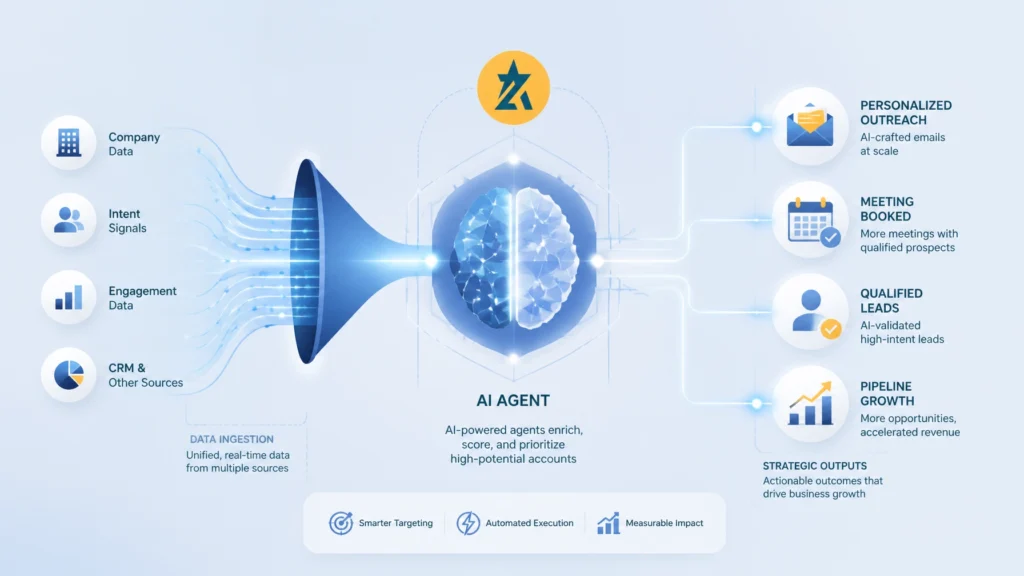
To successfully integrate AI agents, you must move beyond the "if-this-then-that" logic of basic automation. A robust AI agent framework operates on a four-tier architecture: Signals, Decisions, Actions, and Logging.

- SIGNALS: These are the data inputs. Think website visits, product usage spikes, webinar attendance, or intent data from third-party providers. AI agents ingest these signals in real-time, far faster than any human SDR could.
- DECISIONS: This is where the "intelligence" happens. The agent evaluates the signal against your Ideal Customer Profile (ICP). Is this account worth the spend? What is the B.A.N.T (Budget, Authority, Need, Timeline) potential?
- ACTIONS: Once a decision is made, the agent executes. This could be updating your CRM, triggering a personalized email sequence, or adjusting ad spend in real-time to suppress or target specific audiences.
- LOGGING & LEARNING: Every action is recorded. The agent analyzes the outcome: did the prospect reply? Did the SQL convert?: and adjusts its internal logic to improve future performance.
HIGH-IMPACT USE CASES FOR IMMEDIATE ROI
Why settle for generic outreach when you can achieve inch-perfect personalization at scale? Here is where AI agents deliver the most significant impact on your bottom line:
1. LEAD ENRICHMENT AND "SPEED-TO-LEAD"
The faster you respond to an inbound query, the higher your conversion rate. AI agents can instantly enrich a form-fill with technographic and firmographic data, deduplicate the record, and route it to the correct Account Executive in seconds. No more "leaky funnels."
2. INTENT-BASED OUTBOUND RESEARCH
Stop wasting your SDRs' time on manual LinkedIn research. AI agents can scan news cycles, financial reports, and social signals to find a "hook" for every prospect. According to research from Demand Gen Report, this level of AI-driven strategy is revolutionizing how B2B teams handle the top-of-funnel.
3. MULTI-CHANNEL CONTENT SYNDICATION
Managing content across various platforms is a logistical nightmare. AI agents can autonomously identify which whitepapers or case studies are resonating with specific segments and push that content through the most effective channels, ensuring your digital marketing efforts are always data-driven.

YOUR 7-STEP INTEGRATION ROADMAP
Integrating AI agents is a strategic shift, not a technical "flip of the switch." Follow this precision-engineered roadmap to ensure a seamless rollout.
STEP 1: AUDIT YOUR DATA STACK
You cannot build an intelligent system on a broken foundation. Identify every tool in your stack: CRM, Marketing Automation Platform (MAP), and Sales Engagement Tools. Map out the "signals" each system produces.
STEP 2: IDENTIFY THE BOTTLENECK
Do not try to automate everything at once. Pick one high-volume, rules-heavy workflow that is currently a bottleneck. For most, this is Inbound Routing or Lead Qualification.
STEP 3: DEFINE THE GUARDRAILS
AI requires strict parameters to prevent "hallucinations" or off-brand messaging. Define your ICP rules in plain language, set rate limits on outreach, and establish which actions require human approval (the "Human-in-the-Loop" model).
STEP 4: DESIGN A MULTI-AGENT ARCHITECTURE
Rather than one "God Agent," deploy specialized agents that work in concert. A Research Agent finds the data, a Data Agent cleans it, and a Copy Agent drafts the messaging.

STEP 5: THE PARALLEL RUN
For the first 30 days, run your AI agents in parallel with your manual processes. Compare the agent's "decisions" against those of your top-performing reps. Only once the agent reaches a 95%+ accuracy rate should you grant it autonomy.
STEP 6: CALIBRATE AND REFINE
Analyze the "Reply Rates" and "Meeting-Set Rates" of your AI agents. If the copy is too robotic, adjust the prompts. If the routing is off, tighten the ICP filters. Precision requires constant calibration.
STEP 7: INSTRUMENT FOR REVENUE
Tie every agent action to a dollar value. Measure the impact on your SQL-to-Close ratio and your Customer Acquisition Cost (CAC). We guarantee that once you see the ROI, you will never go back to manual demand gen.
THE BOTTOM LINE: WE GENERATE LEADS, YOU GENERATE PROFIT
The integration of AI agents is no longer a luxury for "early adopters": it is a requirement for survival. Companies that leverage these autonomous systems will briskly outpace competitors who are still bogged down in manual prospecting.
At AptZion, we provide the comprehensive services you need to transform your demand gen workflow. From intent data analysis to end-to-end campaign execution, we bring the voice of your customers into the heart of your business with mathematical precision.

Are you ready to unlock world-class growth? Stop guessing and start scaling. Get started today and let AptZion build the robust, AI-driven demand gen engine your business deserves.
Click here to know more about our Lead Generation services.