
Is your demand generation strategy still relying on the "spray and pray" tactics of the early 2020s? If so, you aren't just wasting budget: you are actively inviting litigation. In 2026, the landscape of healthcare marketing has shifted from a wild-west of behavioral tracking to a high-stakes arena governed by "Privacy by Design." For life sciences, medical device, and healthcare SaaS companies, the challenge is simple yet brutal: How do you identify and engage complex buying groups within Integrated Delivery Networks (IDNs) and Group Purchasing Organizations (GPOs) without crossing the line into sensitive data violations?
The answer lies in Signal-Based Targeting. This is not just another industry buzzword; it is the robust, data-driven methodology that separates market leaders from those struggling with shrinking pipelines. By leveraging professional-context signals and Dark Intent Signals, your organization will achieve inch-perfect precision while remaining bulletproof against shifting privacy regulations.
THE 2026 PRIVACY BACKDROP: WHY THE OLD PLAYBOOK IS DEAD
The era of third-party cookie dominance has ended, replaced by a fragmented global rulebook. Between the tightening of HIPAA-adjacent regulations and the surge in state-specific privacy laws, the risk profile for traditional behavioral targeting has skyrocketed. Regulators are no longer issuing warnings; they are issuing fines.
In the healthcare sector, data is inherently "high-risk." Any signal that could be interpreted as revealing a patient’s health status or a clinician’s specific treatment pattern is now a potential liability. If your marketing team is still trying to scrape patient journeys to find doctors, you are playing with fire.
The strategic pivot for 2026 is a transition toward Professional Contextual Targeting. Instead of tracking the person, we track the professional signal. This allows you to reach the right Healthcare Professionals (HCPs) and decision-makers based on their specialty, role, institutional affiliation, and purchasing authority: all without touching sensitive consumer health data.

DECODING THE HEALTHCARE BUYING GROUP
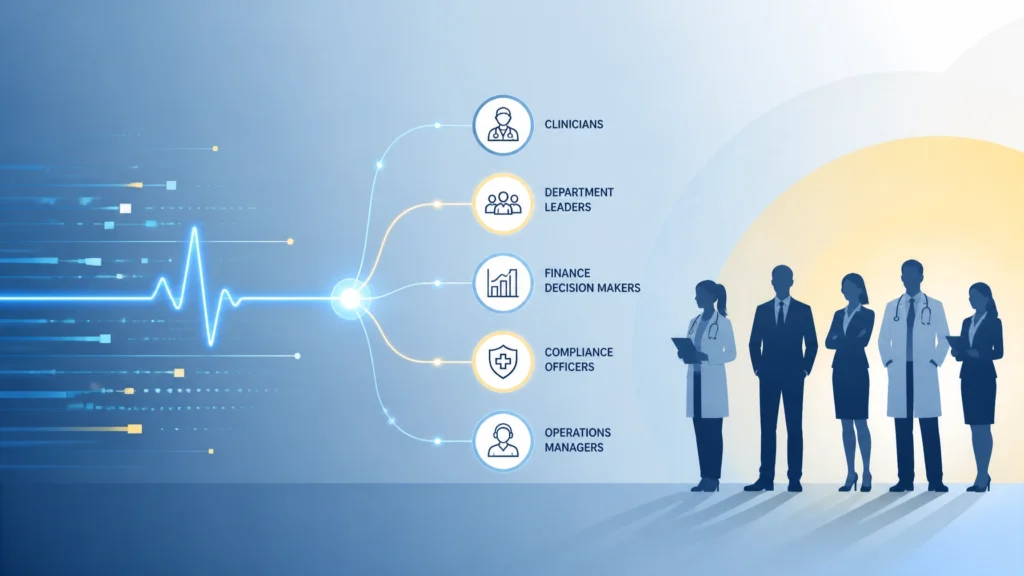
Unlike standard B2B sales, healthcare decisions are rarely made by a single individual. You aren't just selling to a Chief Procurement Officer; you are selling to a "Buying Group" that includes:
- Clinical Influencers: The HCPs who will actually use the product.
- Economic Buyers: The financial executives looking at ROI and cost-reduction.
- Technical Evaluators: IT and security teams ensuring interoperability.
- Governance Committees: Compliance officers vetting regulatory standards.
Mapping these groups requires a sophisticated understanding of Healthcare Growth Strategy. Signal-based targeting allows you to identify when a specific IDN is in a "buying window." Are they researching clinical efficacy for a specific class of medical devices? Are their procurement officers attending webinars on financial oversight? These are the professional signals that indicate a high-intent account.

THE PRIVACY-FIRST PLAYBOOK: FIVE PILLARS OF SIGNAL-BASED SUCCESS
To build a world-class pipeline in this environment, you must adopt a "problem-solver" mindset that prioritizes precision and compliance. Here is how you execute a robust signal-based campaign:
1. PRIORITIZE PROFESSIONAL OVER PERSONAL
Stop looking for behavioral signals that reveal personal habits. Instead, focus on institutional and professional indicators. Signals such as practice size, specialty certifications, formulary status, and medical education participation are high-value, low-risk data points. This ensures you are reaching the doctor in their professional capacity, not as a consumer.
2. LEVERAGE INTENT DATA WITH PRECISION
Intent data is your secret weapon, but only if it is "Clean Intent." At AptZion, we emphasize the use of data that originates from consented, professional environments. Whether it is research downloads or clinical whitepaper engagements, these signals provide the "What" and "When" of the buyer’s journey without compromising the "Who" in a way that violates privacy.
3. IMPLEMENT DATA MINIMIZATION
A common mistake is collecting as much data as possible "just in case." In 2026, the mantra is Data Minimization. Collect only the minimum signals necessary to trigger your outreach. This reduces your attack surface and simplifies your compliance reporting. If you don't need a precise geolocation to confirm an IDN's headquarters, don't track it.
4. CROSS-CHANNEL ORCHESTRATION
Once a signal is identified: say, a surge in research activity from a specific hospital system: your outreach must be brisk and synchronized. This means aligning your Market Research with your email marketing and digital ads. If the signal says "High Intent," your response should be "High Relevance."
5. CONTINUOUS COMPLIANCE AUDITING
Don't wait for a Data Protection Impact Assessment (DPIA) to find a flaw. Your targeting logic should be audited quarterly. Are your vendors still compliant? Is your intent data provider following the latest opt-out requirements? This proactive approach guarantees long-term stability and protects your brand’s reputation.

FROM MQLS TO REVENUE: THE MATHEMATICAL APPROACH TO GROWTH
Why settle for volume when you can have velocity? In the healthcare sector, a massive list of low-quality Marketing Qualified Leads (MQLs) is a liability for your sales team. Signal-based targeting shifts the focus to Lead Velocity.
By identifying accounts that are actively signaling a need, you can prioritize Sales Qualified Leads (SQLs) that have a higher probability of conversion. This data-driven framing allows you to forecast revenue with much higher accuracy. Instead of saying "We hope to close 10 deals," you can say "Based on current intent signals from these 50 IDNs, we will close 8 deals this quarter." This is the kind of precision that C-suite executives demand.
WE GENERATE LEADS, YOU GENERATE PROFIT
At AptZion, we don't just provide data; we provide a strategic partnership. Our end-to-end solutions include:
- Precision Targeting: We find the buying groups others miss.
- Demand Generation: We create the signals that drive engagement.
- Content Syndication: We place your expertise in front of the decision-makers who matter.
- B2B Market Research: We bring the voice of your customer into the heart of your strategy.
Our goal is simple: to help you scale your operations briskly and safely. We understand that in healthcare, trust is the ultimate currency. Our signal-based methodologies are designed to build that trust by respecting privacy while delivering world-class results.

ARE YOU READY TO UNLOCK YOUR NEXT GROWTH PHASE?
The competitive landscape of 2026 does not reward the hesitant. If your pipeline is stagnant or your marketing feels like a compliance nightmare, it is time for a reset. Signal-based targeting is the most reliable, ROI-driven path to reaching healthcare buying groups in a privacy-first world.
Don't let your competition capture the market share that belongs to you. Implement a strategy that is as precise as a surgical strike.
Click here to get started with a custom Demand Generation Assessment or get in touch with our expert consultants today.