
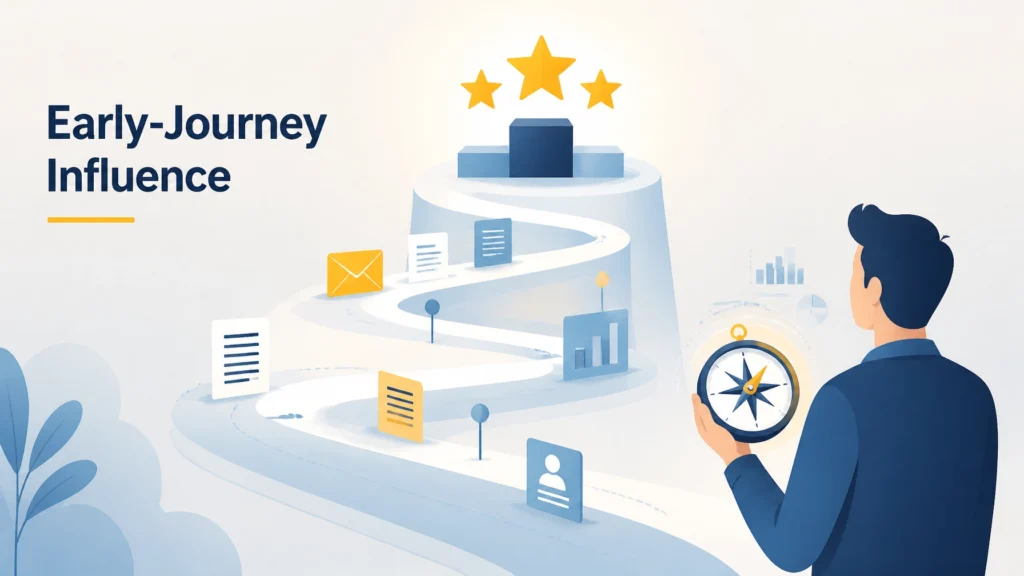
Are you tired of entering the sales process only to find out your prospect has already decided on a competitor? In the high-stakes world of B2B Professional Services, the "Shortlist" isn't created during your sales pitch: it is forged in the silent, early months of the buyer journey. By the time a prospect reaches out for a demo, 70% of their decision-making process is already complete. If you aren't influencing them during that invisible phase, you aren't just late; you are already out of the running.
At AptZion, we specialize in capturing that early-journey momentum. To win the shortlist, you must master the art of being "quietly omnipresent." You need to provide the right insights before the buyer even realizes they have a problem.
Here are the 10 critical things you must know to exert early-journey influence and guarantee your spot on the shortlist.
1. THE 95:5 RULE: MOST OF YOUR MARKET ISN’T BUYING (YET)
The biggest mistake most firms make is focusing 100% of their marketing budget on the 5% of the market that is currently "in-market." According to the 95:5 rule, the vast majority of your potential customers are not currently looking for a solution. However, they will be in the future.
Early-journey influence is about building "mental availability" with that 95%. When their situation changes and they move into a buying cycle, your brand needs to be the first one they think of. This requires a robust digital marketing strategy that focuses on brand salience and educational value rather than immediate conversion. We don't just generate leads; we build the foundation for future revenue.
2. INTENT DATA IS YOUR RADAR IN THE DARK
How do you know which accounts are starting to research your services before they ever visit your website? The answer is Intent Data.

Intent data allows you to track off-site research behavior. If a target account is suddenly consuming high volumes of content related to "financial risk management" or "market research providers," that is a surge signal. By identifying these surges early, you can deploy targeted lead generation tactics to engage them before your competitors even know they exist. This isn't guesswork; it’s mathematical precision.
3. CONTENT SYNDICATION: BE WHERE THE BUYER LURKS
Your website is just one small corner of the internet. To win the shortlist, your expert content needs to live where your buyers are already doing their research: third-party industry portals, news sites, and professional networks.
Through Content Syndication, we take your high-value whitepapers and case studies and place them directly in front of your ICP (Ideal Customer Profile). This creates a "halo effect" of authority. When a buyer sees your insights on a trusted industry platform, your credibility skyrockets, making you a "must-have" on their upcoming shortlist.
4. THE PSYCHOLOGY OF THE SHORTLIST: 2 TO 4 IS THE LIMIT
The human brain can only handle so much complexity. Research shows that most B2B buyers will only shortlist between 2 and 4 vendors. If you are the 5th or 6th option, you might as well be invisible.
To break into that top tier, your messaging must be "inch-perfect." You need to address the specific pain points identified in your market research. Are they worried about compliance? Scale? ROI? Your early-journey content must answer these questions before they are even asked. We provide the professional services needed to map your value proposition to these critical buyer concerns.
5. PERSONA-LED MAPPING: THE COMMITTEE IS WATCHING
In B2B, you aren't just selling to one person; you are selling to a committee of 6 to 10 decision-makers. Each of these stakeholders: the CFO, the CTO, the Marketing Director: has different priorities.
- The CFO wants to see "world-class" ROI and financial stability.
- The CTO wants to see technical compatibility and data security.
- The User wants to see ease of use and efficiency.
Your early-journey influence strategy must include content tailored to each of these personas. If you only influence the "lead," the "committee" will kill the deal during the shortlist phase.
6. DARK SOCIAL AND THE UN-TRACKABLE JOURNEY
A significant portion of the buyer journey happens in "Dark Social": private Slack channels, WhatsApp groups, and peer-to-peer conversations. You cannot track these with standard pixels, but you can influence them by creating "sharable" expertise.
When you release a provocative research report or a unique perspective on industry trends, you become the topic of conversation in these private circles. This "peer-level" influence is often more powerful than any paid advertisement. It builds a level of trust that guarantees you a seat at the table.
7. DEMAND GEN VS. LEAD GEN: PLAYING THE LONG GAME
Are you just collecting emails, or are you creating a desire for your product? While Lead Generation focuses on capturing contact info (MQLs), Demand Generation focuses on creating an environment where people want to buy from you.
Winning the shortlist requires a balance of both. You need demand gen to warm up the market and lead gen to identify the specific individuals ready for a sales conversation (SQLs). At AptZion, we integrate these two functions into a seamless growth engine that drives briskly toward revenue.
8. SALES AND MARKETING ALIGNMENT: THE PRECISION HAND-OFF
The shortlist is often lost in the gap between marketing and sales. If marketing identifies an early-journey signal but sales doesn't follow up with a relevant, non-intrusive touchpoint, the opportunity evaporates.
We advocate for a B.A.N.T (Budget, Authority, Need, Timeline) framework combined with intent data. When marketing sees a surge, sales should receive a dossier on that account, allowing for a "warm" outreach that focuses on being helpful rather than being "salesy." This alignment is what separates top-tier firms from the rest.
9. TRUST AS CURRENCY: THE ROLE OF SOCIAL PROOF
In the early journey, buyers are risk-averse. They don't want to be the one who hired the "wrong" firm. This is where social proof: testimonials, verified reviews, and logo walls: becomes your most valuable asset.
Integrating social proof into your early-stage nurture tracks proves that you have delivered "robust" results for companies just like theirs. It de-risks the decision to add you to the shortlist. Don't just tell them you're the best; show them the numbers.
10. MEASURING INFLUENCE: LOOK BEYOND THE CLICK
To truly master early-journey influence, you must stop obsessing over "last-click" attribution. If a buyer reads your blog post in January, sees your LinkedIn ad in March, and finally reaches out in June, which one "caused" the sale?
The answer is all of them. You need a data-driven approach to measurement that looks at Account Engagement Score. How many people from the target account are interacting with your content? How is their "intent score" trending? By measuring influence rather than just clicks, you can optimize your strategy for what actually drives shortlist wins.
CONCLUSION: WE GENERATE LEADS, YOU GENERATE PROFIT
Winning the shortlist is not an accident; it is the result of a deliberate, data-backed strategy. By influencing the early journey, you position your firm as the obvious choice long before the formal RFP process begins.
Are you ready to take control of your buyer's journey? AptZion is your strategic partner in market research and precision demand generation. We bring the voice of your customers into the heart of your business, ensuring that every touchpoint is an opportunity for growth.
Click here to know more about how we can help you dominate your industry's shortlist. Let’s build your pipeline with "inch-perfect" precision today.