
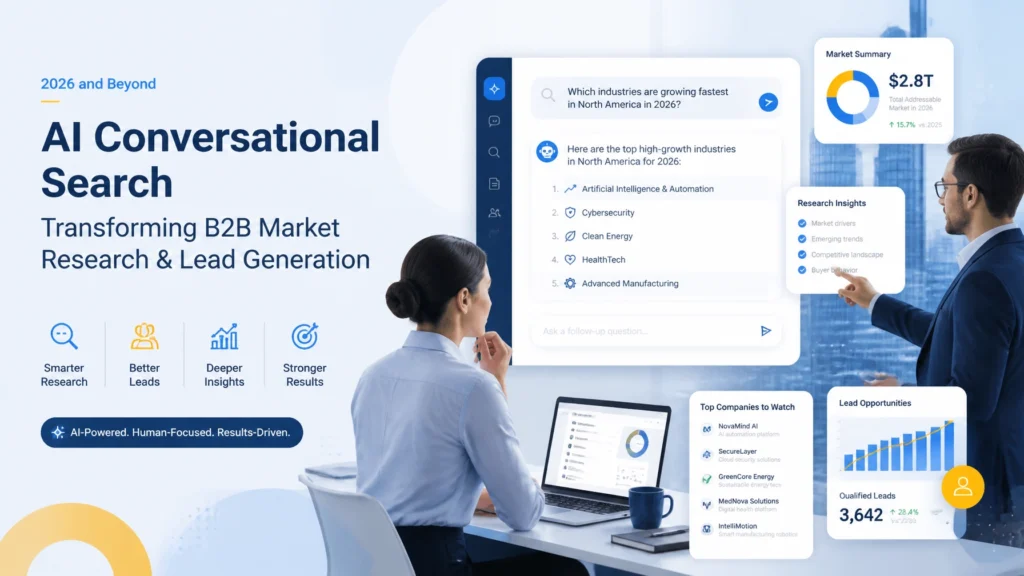
Conversational search is already reshaping how B2B buyers research you and how you research them. In 2026, it is no longer a side channel. It is the primary discovery and research layer.
If your GTM strategy still depends too heavily on website visits, form fills, and last-click attribution, you are already behind. Buyers now use AI assistants to compare vendors, pressure-test claims, build internal cases, and shortlist solutions long before your SDR team sees a signal. That changes how you generate pipeline, how you measure intent, and how you run market research.
Below is a concise breakdown of what is changing and what it means for B2B market research, demand generation, and revenue growth.
1. What “conversational search” means in 2026
When people say “conversational search” now, they mean:
- AI assistants and answer engines like ChatGPT, Gemini, Copilot, and Perplexity
- Google AI Overviews and similar summary layers on top of search
- Natural-language, multi-step queries such as:
- “Compare top B2B CDPs for mid-market SaaS”
- “Shortlist 5 vendors that integrate with Salesforce and offer usage-based pricing”
- “Find a supplier for industrial bearings with same-day shipping in the Midwest”
These tools do not just show blue links. They synthesize content and often answer the question without requiring a click.
2. How conversational search is changing B2B buyer research
2.1 Early research happens off your website
Key 2026 reality:
- Around 80 to 90 percent of B2B buyers report using AI or conversational search in their buying process
- A majority say these tools are more useful than vendor websites for early research
- Zero-click and AI overview results mean buyers can:
- Understand the problem
- Learn solution categories
- Build shortlists
- Compare vendors at a high level
…all before they ever hit your site.
Implication: Early-stage education and vendor framing are now happening inside AI answers, not on your homepage.
2.2 “Dark research” and hidden stages of the journey
Buyers also use AI tools for steps that were never visible to marketing:
- Analyzing RFP responses
- Building internal business cases
- Synthesizing stakeholder feedback
- Stress-testing vendor claims
These actions happen in private workspaces and conversational tools, not in Google Analytics or your MAP.
Implication: A large portion of evaluation and intent formation now happens in channels you cannot tag or track. Your traditional funnel metrics will under-report true engagement and influence.

3. Impact on B2B lead generation
3.1 Traditional SEO → Answer Engine Optimization (AEO)
SEO is not dead, but the success metric has shifted:
- Old goal: rank on page 1 and win the click
- New goal: be cited or influential in AI-generated answers
Answer engines tend to reward:
- Topical authority: depth on specific themes, not isolated keywords
- Entity clarity: your company, product, and category are clearly defined and consistently described across web properties
- Structured information: schema markup, FAQs, product spec tables, pricing models, and integration lists
- Proof and specificity: concrete examples, metrics, comparisons, and step-by-step explanations that are easy for LLMs to reuse
If answer engines see you as an authority on a topic, they are more likely to:
- Mention your brand organically in responses
- Use your content as a source when summarizing
That is the new position zero.
3.2 Lower traffic volume, higher intent
Because AI overviews answer the basics, fewer people click through:
- Many B2B sites are seeing 20 to 30 percent declines in organic sessions even when rankings have not moved
- But the people who do land on your site often come later in the journey and are more qualified
Implications for lead gen:
- Fewer form fills and MQLs, but:
- Higher engagement per visitor
- Higher conversion rates from visit to opportunity
- Pipeline can stay stable or rise while your web metrics look worse
You need to decouple perceived performance like sessions and CTR from actual performance like pipeline and revenue.
3.3 Third-party presence matters more than your own pages
When a buyer asks an AI assistant for vendor recommendations, it leans heavily on:
- Review sites like G2, Capterra, and TrustRadius
- Analyst reports
- Marketplaces and procurement platforms
- High-authority niche publications
- Customer communities and forums
Implication: Lead generation now depends as much on the strength and clarity of your off-site footprint as your own domain.
You are optimizing an ecosystem of references, not just your website.
4. How conversational search is changing B2B market research
There are two big shifts here: how you collect data and what you can measure.
4.1 From forms and static surveys to conversational, dynamic research
Market research is adopting the same UX as conversational search:
- Conversational surveys: chat-style questionnaires that feel like dialogue, with branching logic based on previous responses
- Higher completion and richer data: some teams see up to 40 percent better completion than linear forms and much more open-ended commentary
- Real-time NLP: AI categorizes open text, detects sentiment, and surfaces themes on the fly
This aligns with how buyers now expect to interact: by typing or speaking in natural language and receiving smart, context-aware follow-ups.
4.2 From “click intent” to “dark intent”
Legacy intent models rely on:
- Page views
- Content downloads
- Ad clicks
In a world where AI does much of the heavy lifting, those signals miss the real picture.
2026 buyer-intent trends:
- Dark intent from conversations: AI analyzes unstructured data such as sales calls, chat transcripts, community posts, and support tickets to detect intent and urgency at the account level
- Real-time, micro-moment signals: instead of static in-market lists, models update continuously as they detect changes in language such as new pain points, budget talk, and timing cues
- Account-level prediction: instead of tagging individual leads, marketers track accounts showing patterns consistent with buying behavior across multiple channels
Market research teams increasingly work with:
- Conversation intelligence tools from sales calls
- Community monitoring
- AI text analytics on NPS feedback, open survey responses, and qualitative input
The research output shifts from “what percentage clicked X” to “what patterns of language and behavior predict a buying cycle.”

4.3 Measurement and attribution are structurally harder
Because buyers learn so much from AI and closed environments, your analytics miss:
- Non-click interactions in answer engines
- Internal sharing of AI-generated summaries about your product
- AI-assisted RFP scoring that affects your win rate
That is why many marketing teams now:
- Rely more on lift-based and incrementality thinking, such as asking, “When we do X, does pipeline from this segment rise over 90 days?”
- Use qualitative proof through buyer interviews, including questions like “Where did you first hear of us?” and “Did you use AI tools to research this?”
- Measure contribution to revenue at the account level instead of obsessing over touch-level attribution
5. Key 2026 trends you should internalize
Summarizing the most relevant trends:
-
AI search is the primary discovery channel.
Buyers start with ChatGPT, Perplexity, and Google AI Overviews as often as, or more than, Google itself. -
Zero-click and AI overviews reduce visible engagement.
Traffic and top-of-funnel metrics under-report your true influence. -
Answer Engine Optimization (AEO) replaces keyword-first SEO.
Optimize for topical authority, entity clarity, FAQs, schema, and proof content. -
Third-party authority is critical.
Reviews, marketplaces, analyst coverage, and communities heavily influence AI answers and human trust. -
Conversational surveys and research tools are rising fast.
Chat-style surveys, in-product questionnaires, and always-on feedback bots provide richer qualitative data. -
Dark intent and unstructured data drive insight.
AI mines emails, calls, chats, and community content for signals of pain, priority, and timing. -
Agentic AI runs parts of the funnel.
AI agents qualify leads, respond to inbound enquiries conversationally, route opportunities, and trigger personalized nurture without manual intervention.
6. What to do practically
If you are responsible for B2B research or lead generation, orient around these actions:
-
Map how your ICP uses AI today.
Ask recent wins and losses specific questions about which AI tools they used, when, and for what. -
Build topical authority on a few critical themes.
Create deep, structured content hubs with guides, FAQs, comparison pages, and implementation playbooks that LLMs can easily digest and reuse. -
Make your data machine-readable.
Use schema markup, clear product and pricing structures, consistent naming, and well-formatted spec and comparison tables. -
Strengthen off-site proof.
Systematically grow reviews, case studies, and listings on platforms your buyers and AI models trust. -
Adopt conversational research methods.
Implement chat-based surveys, post-demo feedback bots, and qualitative research programs. Let AI summarize themes, objections, and market patterns briskly. -
Rebuild your measurement model.
- Focus on account-level pipeline, win rates, and cycle time
- Use buyer self-reporting such as “How did you find us?” and periodic qualitative research to fill gaps analytics cannot see
-
Prepare your GTM teams for AI-informed buyers.
Sales and CS should expect prospects to show up with AI-generated comparisons and objections, and they should be ready with evidence-backed responses.
Conclusion
Conversational search is not just changing SERPs. It is changing how B2B buyers discover, evaluate, and validate every serious purchase decision. That means your research model, your demand gen engine, and your revenue strategy all need to adapt.
If you want stronger pipeline in 2026, you cannot optimize only for clicks. You need inch-perfect visibility across AI answers, third-party trust sources, conversational research inputs, and account-level intent signals. This is where robust market research and precision demand generation start working together.
At AptZion, we see this shift clearly: the brands that win will be the ones that treat AI discovery as a strategic growth channel, not a side experiment. Get your data structured. Strengthen your off-site footprint. Upgrade your research workflows. Then let your GTM teams act on real buyer intelligence.
If you share a bit about your industry, deal size, and current go-to-market motion, this framework can be tailored into a more specific playbook for your business.